

FR 172: Hexagons Everywhere
Thoughts on Boards of Canada, plus new LPs from K Wata, Bill Orcutt & Mabe Fratti, and more.

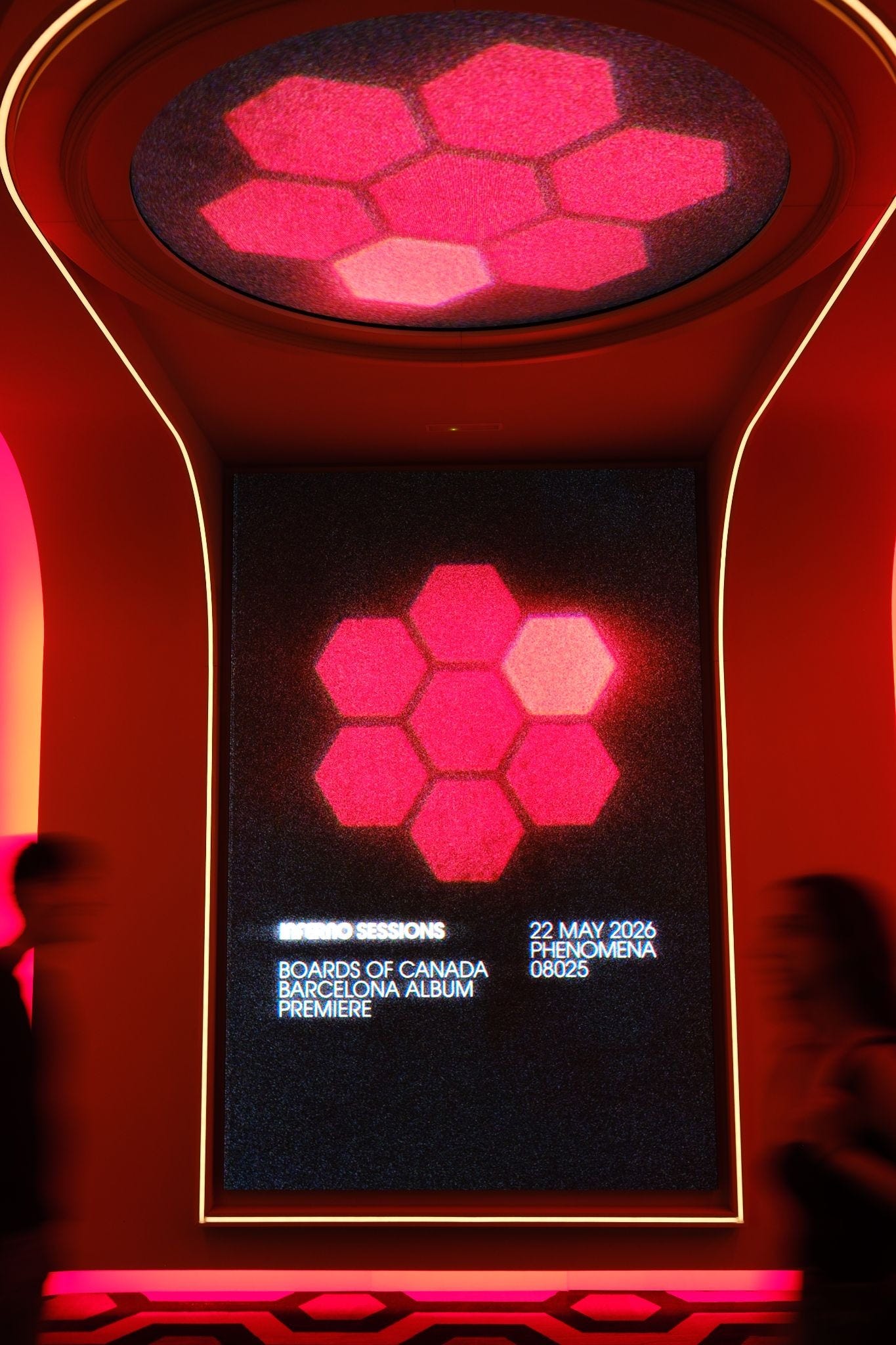
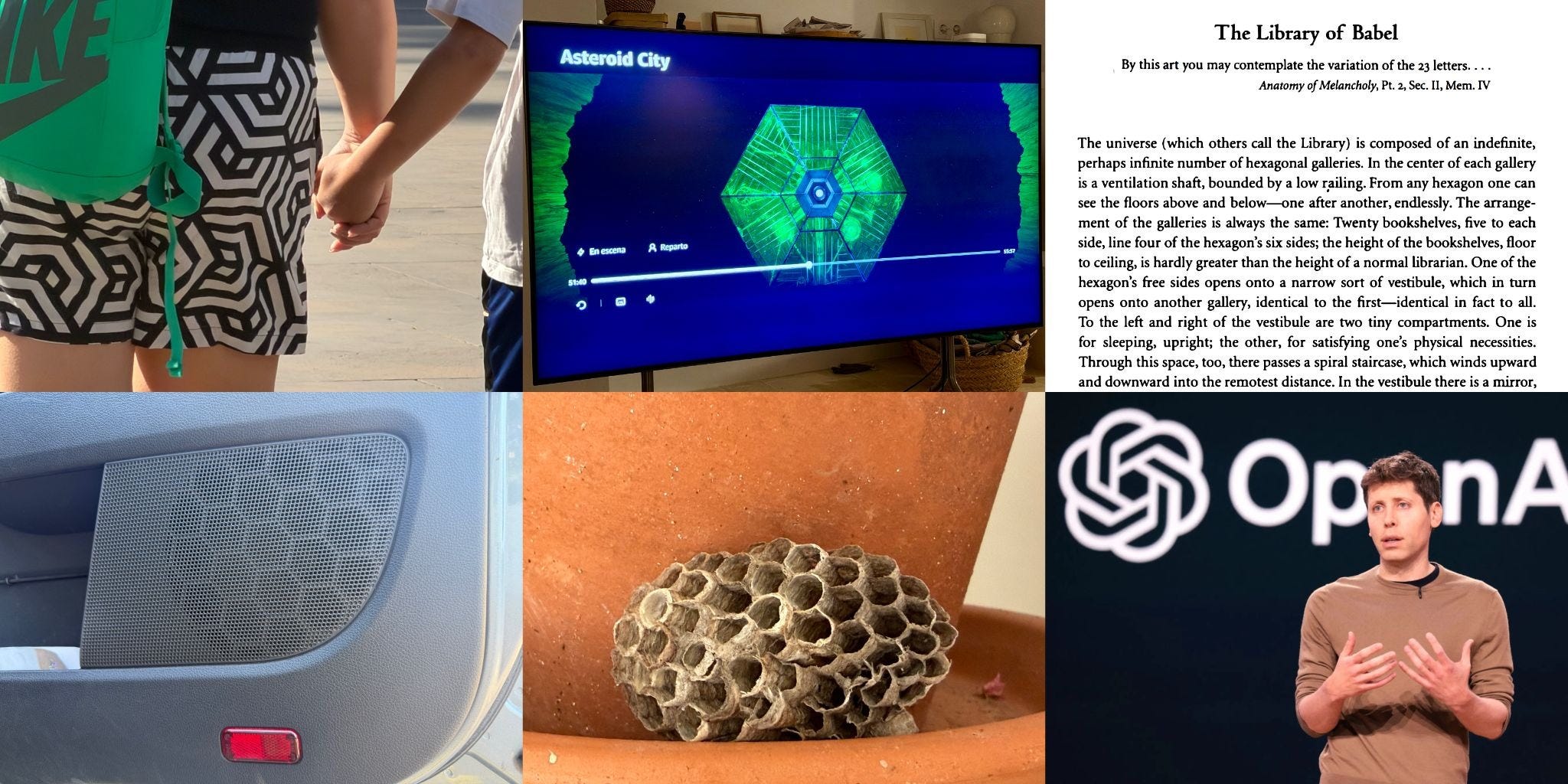
In my review of Boards of Canada’s Inferno for Pitchfork last week, I mentioned that, in the days following a Barcelona listening session a week prior to the release, I suddenly seemed to see hexagons everywhere I looked. I wasn’t exaggerating. It was as though I’d stepped into Pynchon’s The Crying of Lot 49, except instead of muted horns, they were six-sided polygons.
I kept a little running visual diary of my finds, most of which I texted to my friend Ben Cardew, who had attended the listening session with me, with some variation of the thought: Can you fucking believe this? The sightings started the morning after the screening, walking from Ben’s apartment to the metro station, where I spotted a woman with hexagon-print shorts walking hand in hand with her son, and whipped out my phone just in time to get fleeting proof. And over the next couple of days they just kept coming.
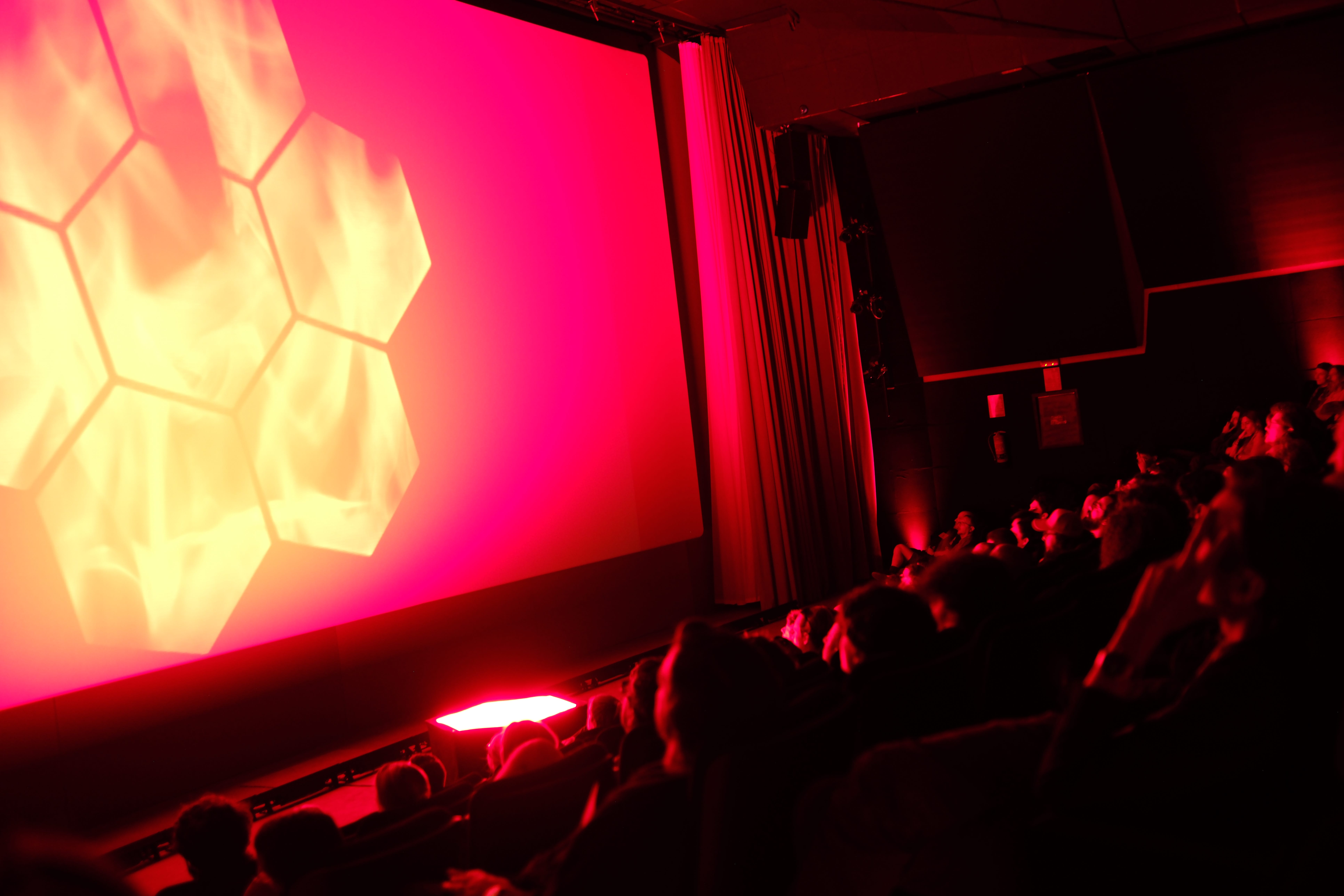
As I mentioned in my review, there was even a hexagon pattern woven right into the carpet of the movie theater where they held the listening session. I couldn’t help but wonder how much the choice of venue came down to that fortuitous detail.
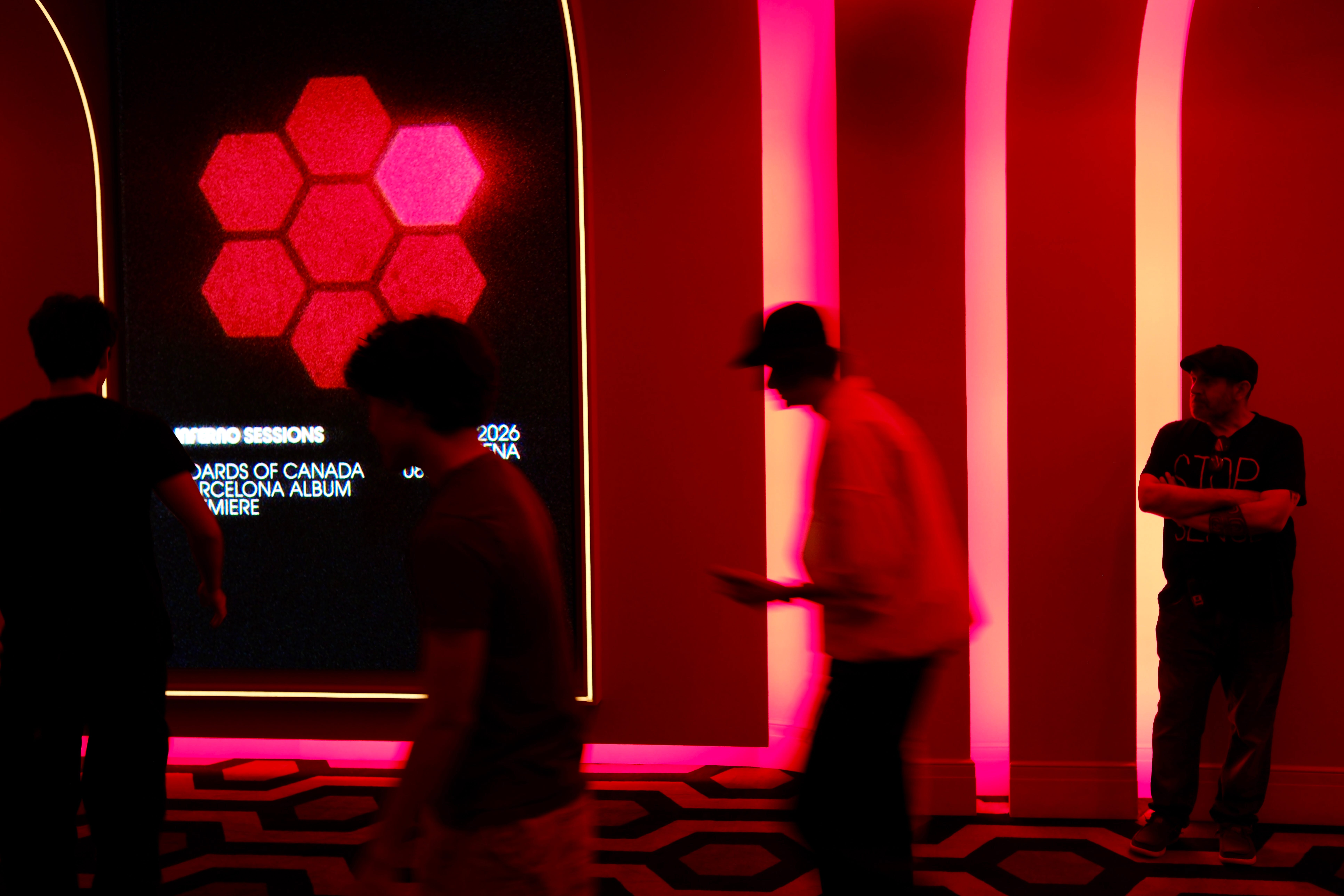
I’m what I suppose you would generally call a fan of Boards of Canada; I bought Hi Scores when it came out in 1996 (and picked up a second copy in the cut-out bin at Kim’s Video for something like $4 in the late ‘90s which seems insane to me now). I loved Music Has the Right to Children and Geogaddi in their day; my attention drifted a bit by the time of The Campfire Headphase and Tomorrow’s Harvest, though I enjoyed getting reacquainted with them while I was researching my Inferno review. But I’ve never been a hardcore fan. The Lore has always left me a bit cold; I’ve never felt much impulse to devote energy to decoding their music or dissecting their intentions. (I feel exactly the same way about Aphex Twin.) So I was surprised at how much I enjoyed the experience of the listening session. To sit with a group of fellow fans in a darkened room for the express purpose of simply listening to an album—that felt special, the kind of communal experience that is increasingly rare. The energy was entirely different from a concert. And the fact that almost no one had actually heard the thing yet lent an expectant air to the proceedings. People showed up with open ears and open minds, and they remained attentive for the entire 70 minutes. I didn’t hear a word spoken for the entire duration that the music played, which was especially nice.
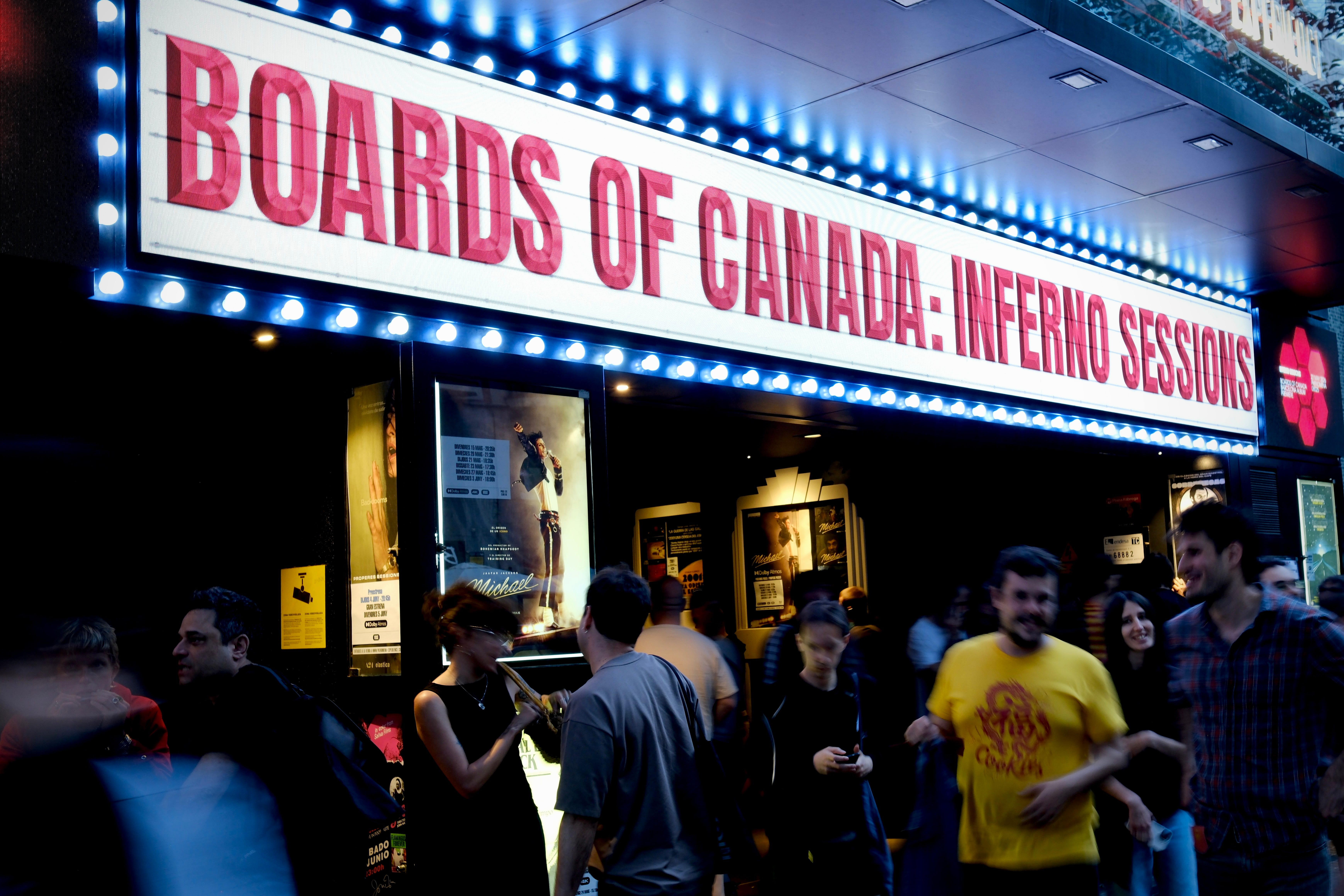
I didn’t stick around afterward, so I don’t know what the general assessment was like. I’ve enjoyed seeing all the reactions online in the wake of the album’s release, though I’ll admit that I’ve also been a little surprised at how polarizing they can be. I totally get not liking Boards of Canada, or not caring about them, but believing them to be as bad or fake or pernicious as some people seem to—I don’t really see it. I do wonder if some of that is a reaction to the over-the-top praise and extreme feats of exegesis performed by a subset of their most obsessive fans. And speaking of them, perhaps the most bemusing aspect of the album release has been seeing how thoroughly stan culture has permeated even the supposedly elevated world of IDM. I’ve read post after post from people mad that Inferno—awarded Best New Music and a generally astronomical score—didn’t get a higher score, yet not one of those people has engaged with the actual content of the review. (I’m also confused by the Reddit users saying something along the lines of, We don’t need some reviewer to tell us what to think. Are reviews and Reddit threads not in fact expressions of the very same impulse—that is, the desire to come together and share ideas about music?) Given that it’s an overwhelmingly positive review, I can only guess that they didn’t actually read any of it. It’s clear that for the stans, it’s entirely a numbers game.

For the record—well, you can read what I think about it here. But I think it’s a great record, easily their best since Geogaddi, maybe even better. Some people seemed annoyed by the sound design, but I love the sharpness and vividness of the sounds here; it’s widescreen and hi-def, almost a little over the top in places—like, say, ML Buch. I love the ultra-vivid guitars, which make me think of the Cure (insert arm wrestling meme: “Boards of Canada” on the left, “Olivia Rodrigo” on the right, “the Cure” super imposed over their clasped fists). I love the size and scope of the drums, which do everything that Boards of Canada drum programming is supposed to do. And I think all the samples and voices are cannily done—there’s just enough to chew on if you’re into that kind of thing, but not so much that it becomes distracting. I can understand why some of the evangelical voiceovers might be a turnoff; the choppy, chirpy voices in “Father and Son” really do sound like they come from the kind of podcast Ned Flanders would listen to. But I actually appreciate the fact that there’s something a little bit ridiculous about that song. It undercuts some of the seriousness of all the myth-mongering around Boards of Canada, turns them back into a couple of mischief-makers out in the Scottish countryside.
The only mystery I’m left wondering about: Why does Mike Sandison have the only writer/producer credit on the album, even though Marcus Eoin remains credited on electronics, tape, “processes,” and sound design? And is there a pub somewhere in the rural Scottish highlands where if I hang around long enough I’ll find out?
There are so many good records coming out lately that I feel like I’m struggling to keep up. This week’s newsletter features a few real doozies, including unmissable dub techno from K Wata, a sui generis techno reinvention from Ibrahim Alfa Jnr., Balearic noir vibes from Total Blue’s Anthony Calonico, an ambient stunner from Lucas Dupuy, and more. I’ll be catching up with all the essential new releases I’ve missed in an upcoming newsletter.
Read on.
Paid subscriptions are $5 a month or $50 a year; perks include exclusive playlists for chilling and clubbing (now available on Tidal as well as Apple Music, Deezer, and Spotify); Eavesdropping, a new series of mixes by me; the ongoing Mixes Digest series; and full access to the archives, including interviews with Bill Orcutt, Kara-Lis Coverdale, Call Super, Avalon Emerson, Nick León, and more.
Records of the Week
K Wata: Give U Space (Short Span)
K Wata’s music skulks; it swerves; it slinks. (Fittingly, Slink is the name of the NYC artist’s crew.) Give U Space, his debut album, conveys the sense of shapes flitting through the darkness, silvery and evanescent. It has a gestural quality, like someone moving their hands suggestively in the air—but in your peripheral vision, so it’s never quite clear what they are trying to communicate. Like a lot of releases on Short Span, which in a very short span of time indeed has become one of the most consistently excellent labels going, it takes dub techno as its stomping ground; in fact, K Wata’s album is probably the most canonically dub techno record of any of his labelmates’ records. Rhythm & Sound and Pole are obvious inspirations, and so is the mid-2000s run of the Modern Love label. But K Wata’s music never sounds derivative of its influences, not the slightest bit.
What is it, then, that makes him sound so original? Honestly, I’m not sure; I think it probably has something to do with his sound design, particularly the way so much of his palette sounds like sculpted air, hissing and wheezing, gusty in a way that you can practically feel grazing your skin, buffeting your face. His bass is unreal—vast, gargantuan, but never overpowering; it doesn’t so much weigh things down as radiate energy outward, assisting in the illusion that all the other elements of the music are suspended in midair, and you levitating right along with them. I’m leery of hyperbole but this feels to me like one of the definitive dub-techno records of the decade, and a lasting addition to the canon.
Ibrahim Alfa Jnr.: Infinite Black Inside (FO)
Thanks to HD Angel for emailing to urge me to check out Ibrahim Alfa Jnr.’s Infinite Black Inside, an album I’d seen discussed here and there, but hadn’t yet heard. Only after falling for it, hard, did I realize it had come out on FO, the latest label from Peak Oil founder and Kranky label manager Brian Foote, whose releases I’m always going to make time for anyway. It’s an incredibly curious record, with no real stylistic hallmarks to peg it to any given time or place; if you told me it was a reissue of something from 20 years ago, I’d believe you, but there’s also nothing retro about it—quite the opposite; Infinite Black Inside calls back to a moment when electronic music still felt like it held the promise of infinite futures inside it.
Alfa is a British artist who came up in ’90s Bristol and London, recording for labels like Christian Vogel and Si Begg’s Mosquito and Justin Berkovi’s Nightrax. He was wildly prolific up until the mid-2000s, then got sidelined for a spell by a prison sentence. Around 2015, he returned with a vengeance, with a string of albums for Workshop and Mille Plateaux, but his battle with diabetes hasn’t made things easy for him. (A fascinating 2024 Bandcamp feature tells his story.)
It figures that he has historically been so prolific, because Infinite Black Inside sounds like the work of an artist who has more ideas than he knows what to do with; practically every track here could be the jumping-off point for an entire album in a similar style. At the same time, though, there’s nothing disorganized or unkept about Infinite Black Inside; this is chaos at its most elegantly organized. Across 12 tracks, mostly around three minutes long, he breaks techno open and rearranges its clockworks, like a kid taking a screwdriver and a soldering iron to a piece of gear found on the sidewalk.
The rhythms tend to be broken—the trap hi-hats of “Subutrax,” the tumbling toms of “Naked Lunchbreak”—but they’re not always; “Latent” is a slow-mo house glide, “Inwards Reverse” a hissing downbeat dub beat. They do shift with every single track, though, and most follow completely sui generis patterns, as though rejecting the notion that electronic music should follow any kind of rhythmic template in order to be understandable. His tonal world is no less thrilling: Whatever materials he’s using (and I’m guessing it’s a mix of hardware and soft synths, but I have no idea), every track is a three-dimensional constellation of billowing chords and ultra-vivid timbres. I hear Aphex Twin, Drexciya, Actress, even Boards of Canada (“Capture” could absolutely pass for a Music Has the Right outtake); more than anything, I’m reminded of Urban Tribe’s great The Collapse of Modern Culture, another album that took techno convention and turned it inside out. Infinite Black Inside feels like one of those rare records that fills a hole in your life—a hole you didn’t even know you were waiting to be filled.
Albums
Bill Orcutt & Mabe Fratti: Almost Waking (Unheard of Hope)
Bill Orcutt’s guitar can be gnarled and knotty, and it can be wistful, even sentimental, but I don’t think it’s ever sounded as easygoing as it does here, alongside Mabe Fratti’s cello (and, on a couple of tracks, voice). Whatever accounts for the rosy outlook, both musicians sound unusually in sync here; the differences between their instruments mean that it’s never difficult to figure out who is doing what, but even still, I could rarely tell you who’s leading and who’s answering, if either of them. The pieces dovetail: Orcutt picks out roomy chords, and Fratti slides her cello diagonally inside, so that the pieces hold fast. I’ve been trying to think of what the opening title track reminds me of, and it just came to me: Hugo Largo’s great Drum, thanks to the song’s effortless amalgam of melody and drone.
One of the things that works so well about the record, I think, is that despite their mirrored sensibilities, they frequently come at the songs from different perspectives: Orcutt is restless, attacking the song from all angles (see, for instance, his solo in “The Heaven of Our Misery”), while Fratti is perennially patient, as though playing the long game. One exception: “Steps of the Sun,” where she trades bowing for plucking, playing her instrument more like an acoustic bass, and the two musicians’ parts clasp together like a pair of interwoven fingers. And while the tonal palette remains consistent throughout, they keep finding new harmonic and rhythmic ideas, all the way to the very end: closer “A Rural Pen” might be the most emotionally intense song of the whole album, summoning all the spookiness and yearning of Arthur Russell at his most radiant.
Anthony Calonico: Spacious Heart (Music From Memory)
Two years ago, when Total Blue dropped their instant-classic self-titled debut (FR73), I tried to figure out where this out-of-the-(total)-blue trio had come from, and didn’t turn up much. Nicky Benedek had the longest track record, with two-plus decades of records on labels like Leaving, L.I.E.S., PPU, and Second Circle, and Alex Talan had a very proto-Total Blue project under the alias Coolwater, but I couldn’t turn up much info at all about Anthony Calonico. With his debut solo album, Spacious Heart, the L.A. musician fills in the blanks. Now, more than ever, I wonder exactly what separates the three musicians in the trio, because Spacious Heart sounds just as much like Total Blue as the Coolwater EP did; Talan and Calonico, at least, are clearly vibrating on remarkably similar frequencies, spinning influences like Mark Isham, Mark Hollis, Wally Badarou, and Thomas Dolby’s The Flat Earth into noirish smooth jazz fueled by fretless bass and wind synths.
Spacious Heart picks up where Total Blue left off; it gives the same sense of floating in an aquamarine cove beneath the light of the full moon. Brushed hi-hats flicker like phosphorescence; Rhodes and reeds glow warmly/coolly; the synth pads are as watery a sound as circuitry can summon. There’s a jazzier sensibility this time out, particularly on songs like the piano-led “Hillside”; “Whispers,” led by some of the most beautiful fretless bass I’ve heard in ages, sounds like a fusion of Thomas Dolby’s “Screen Kiss” and Seal’s “Violet,” making it essentially a song I’ve been waiting to hear for 30-plus years, a blue-moon addition to a genre I’ve long fantasized about and rarely encountered in the real world. The biggest change this time is that Calonico sings on several tracks, and when he does, it’s lovely. He’s got a downcast murmur of a voice—melancholy but never maudlin, down but not out, and always effortlessly cool, evoking as much with the rounded buzz of his baritone as the words themselves. It took me a while to figure out who he reminded me of, and then it hit me: the Mark Eitzel of 60 Watt Silver Lining, right down to that album’s air of last-call melancholy. One of the finest Music From Memory releases in a while.
Lucas Dupuy: As in Leaves (Acoustic Images)
In ambient music (as, perhaps, in all styles of music), the easiest listen might be the hardest thing to do really well—the tones frictionless, the harmonies placid, the structure unobtrusive. Ninety-nine percent of the time, the results will be boring, or, worse, completely negligible. (Not even merely forgettable, because to forget something, you have to notice it in the first place.) But every now and then, the planets line up and a record comes around where placid, understated beauty turns somehow transcendent. Lucas Dupuy’s As in Leaves is one of those. As on Heal, his wonderful 2025 collaboration with Pavel Milyakov, the fundamentals consist of synthesizer pads, lots of reverb and delay, and not much else. (Perhaps there’s a guitar in “Leaves”?)
The tones are lightly shirred, and they’re layered for maximum ambiguity; despite the outward simplicity of the music, the more you listen, the more unclear the details become. The mood ranges anywhere from beatific to blissfully blank, though there are suggestions of darker energies in tracks like “Helios,” with its faint pulse and what almost sound like seagull or dolphin cries, but without the faintest trace of new-age treacle. I’m reminded of Biosphere albums like Substrata or Man With a Movie Camera; the chilly yearning of “Amb08” is a dead ringer for (Ch-Vox)-era Seefeel, or even Aphex Twin’s SAW II. It takes a skilled hand and patient ears to make something at once so empty and so full.
Heathered Pearls: Window (Heathered Pearls)
Nearly six years since his last album, Cast, Jakub Alexander sidles back onto the scene with an understated but gorgeous self-released new album. He’s all but banished the drums, drifting deep into dubby ambience. “Sleep Archive,” despite the title, couldn’t be further from the skeletal punch of its (possible) namesake; instead, it’s just glancing chords over a charcoal throb, a pillow with an earth mover’s soul. “Zero Repeating” puts an almost trance spin on dub techno; “Slow Flower” might be the Field caught in freeze frame. My favorites, though, are the fluttering “Soft Lock” and “Lime Kin,” both of which recall the feathery pulses of Vainqueur’s Elevations, one of my favorite dub-techno albums of all time.
Wanderwelle: Ghosts Beneath the Brine (Important)
Ghosts Beneath the Brine is the third part of Dutch collective Wanderwelle’s trilogy about the climate crisis and its effect on coastal ecosystems; once again, they weave together seafaring tales and myths with thematically resonant sound sources. Black Clouds Above the Bows used processed cavalry horns to sound the alarm about storm systems gathering strength; All Hands Bury the Cliffs at Sea utilized a damaged church organ that had fallen prey to a cliff collapse; Ghosts Beneath the Brine utilizes cymbals that were submerged in seawater and then played with a bow “at various stages of corrosion.” I would never have known that if they hadn’t told me, and as for the corrosive effects of saltwater on the cymbals, I’ll have to take their word for it, but I certainly appreciate lengths they went to in order to source such evocative sounds. And there’s an appropriately underwater feel to the album, which is full of deep drones, scraped metal, and almost voice-like sounds that add to the uncanny air. The overall effect is a bit like Bryars’ Sinking of the Titanic, just decades later, when all is rust and barnacles and the silted organic matter of countless decaying sea animals—elegant, spooky, and sad.
Balmat News
Laurence Pike: Possible Utopias for Jazz Quintet (Balmat)
Laurence Pike is an Australian drummer with a remarkable CV: He’s played in the Warp-signed trio PVT (né Pivot), post-post-punk greats Liars, alongside Luke Abbott in the trio Szun Waves, and in Triosk, who put out a fantastic collaborative record with Jan Jelinek on ~scape in 2003. Possible Utopias for Jazz Quintet, despite the title, is a solo album, and it’s not really jazz, either—though it’s not not jazz (which seems to be a growing theme on Balmat). It reminds me in places of Burnt Friedman, and its theme—the search for a possible music using hyperreal means—certainly recalls Friedman’s work. I think he recorded it largely playing live and triggering various software processes, though to be honest I’m not entirely sure. It’s the kind of record I listen to and can’t figure out what’s going on, in the best way. Albert Salinas, my partner in Balmat, just happened to be visiting me a day or two after Laurence sent the demo, and we sat in my kitchen mouths agape. It’s out now and it’s stupendous.
Play Time: Magic Object (Balmat)
We just announced a couple weeks ago: The debut album from Play Time, the trio of Ben Vida, Booker Stardrum, and Will Epstein. After finding their footing together during a residency at Kingston, NY’s Tubby’s, they set up for a couple days in a converted barn upstate and hit “record” while they jammed for seven or eight hours a stretch on Moog, percussion, and saxophone; Magic Object represents the highlights of those improvised sessions. I’m reminded in places of Joshua Abrams’ Natural Information Society, or some of Oren Ambarchi’s work; it’s hypnotic and evolving and completely immersive. First single out now, full album drops July 3; if you’re in New York, you can catch Play Time live at Tempo (Kingston) on July 8, and at Brooklyn’s Public Records on July 9.
Thanks for reading!
I’m definitely catching a David Sylvian vibe from the Calonico record—the languid quality, the low pitch of his voice. Not a bad thing at all. It feels tailor-made for listening in a dark room.
"The Lore" is totally my issue with BoC, or the fanbase I guess. I love all of their albums but let's be realistic, at the end of the day they are just two blokes making brilliant electronic instrumental music, they're not solving world hunger and they're not offering new metaphysical ways of seeing the world. Their use of samples and numbers is brilliant but it's just samples! Anyway great article (again!).